
Do veneers change your bite?
Veneer thickness and contour directly affect how teeth meet.
[2]The short answer
Veneers can change contact points if their thickness or shape alters how teeth meet. The bite should be checked at fitting and reassessed if chewing feels high, uneven or uncomfortable.
[2]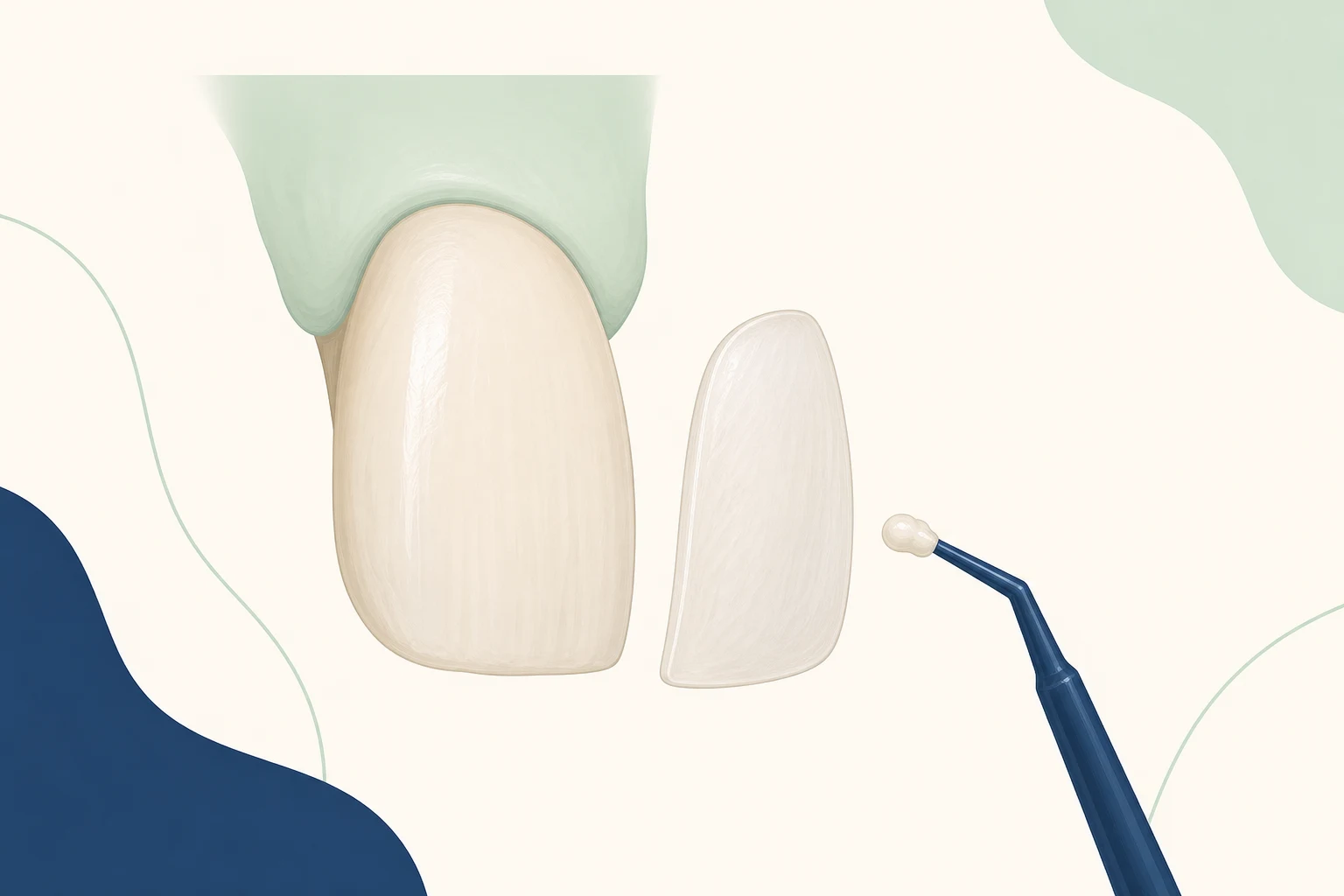
Bite contact and veneer thickness
| Answer part | What the research shows |
|---|---|
| Direct answer | Veneers can change contact points if their thickness or shape alters how teeth meet. The bite should be checked at fitting and reassessed if chewing feels high, uneven or uncomfortable.[2] |
| What changes it | Before veneer placement, the assessment covers teeth condition, gum health, existing restorations, and how upper and lower teeth relate.[2] |
What the pre-treatment assessment covers
Before veneer placement, the assessment covers teeth condition, gum health, existing restorations, and how upper and lower teeth relate. Active decay or gum disease requires treatment first. Placing a cosmetic covering over an untreated condition does not resolve the underlying problem.
[2]Enamel removal, durability, and ongoing disease risk
Traditional veneers require removing a thin layer of enamel, which does not grow back. A placed veneer can crack, chip, loosen, or eventually need replacement. Disease can also progress beneath or around the restoration. Reporting abrupt changes; loosening, pain, or chewing difficulty; to the dental team is preferable to waiting for a scheduled appointment.
[2][4]Veneers versus crowns and orthodontic care
A veneer bonds to the front surface of a tooth and alters its appearance without encasing the whole structure. A crown is considered when the tooth needs broader protection; when a filling is large, when fracture risk is present, or when previous treatment has weakened the tooth. Orthodontic care moves teeth to change their alignment; it is a separate pathway from cosmetic surface payer review.
[2]Frequently asked questions
Can bite discomfort after veneer placement resolve on its own,?
Minor adjustment to a new contact is common in the first days, but persistent discomfort; particularly a feeling that one side sits higher than the other; should be reported. The dental team adjusts veneer thickness at or after fitting; adapting a chewing pattern around an uncorrected high contact may cause wear over time.
[2]How does a crown differ from a veneer in terms of bite payer review,?
A veneer covers only the front surface of the tooth. A crown encases the entire tooth and is typically chosen when the tooth needs broader protection or when a veneer cannot achieve a stable margin. A crown affects more contact surfaces than a veneer and is the more likely option when an existing restoration is large.
[2]What must be treated before veneers can be placed,?
Decay and active gum disease require treatment before veneer work proceeds. The pre-placement examination covers teeth, gums, existing restorations, and the bite. Addressing the underlying condition first means the veneer will bond to a stable, healthy surface.
[2]Who wrote this page
This library is published by Dental Nation, a licensed dental group practising in the United Arab Emirates. Pages are written and overseen by the same clinical team that treats patients in our clinics, and are held to a fixed editorial standard for safety and accuracy.
This page is patient education, not medical advice, and cannot replace an examination. Anything urgent — facial swelling, trauma, uncontrolled bleeding or severe pain — needs a dentist or emergency care now.