Dental Nation
Treatment guide

Coronectomy

For an impacted lower wisdom tooth close to the inferior alveolar nerve, coronectomy leaves the roots and lowers nerve-injury and dry-socket risk.

[2][4]

The short answer

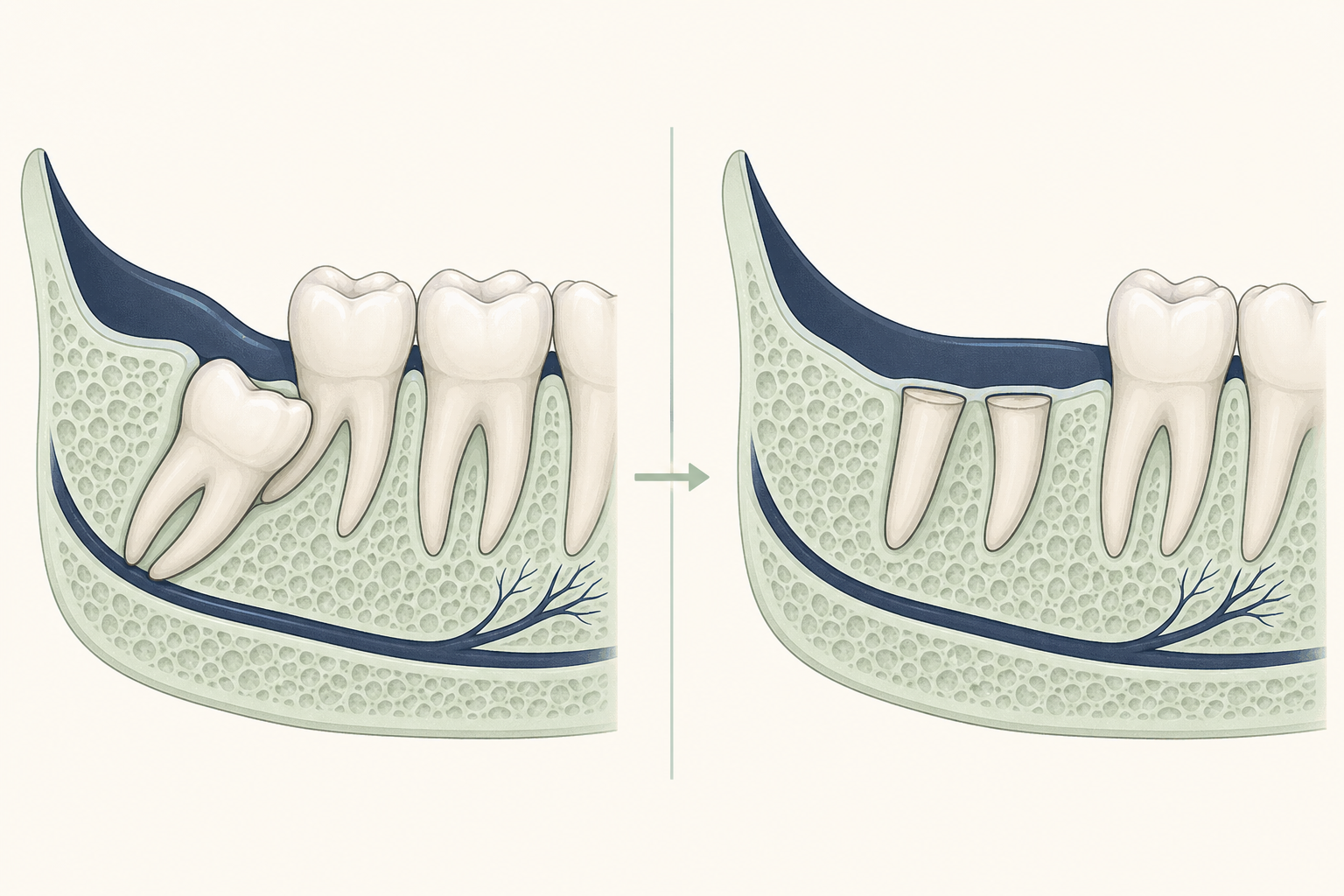
Coronectomy is an alternative to complete removal of an impacted lower wisdom tooth: the crown is removed while the roots remain, reducing inferior alveolar nerve injury risk.

[3]
Coronectomy dental educational illustration

What the change looks like

Illustrative diagram: Coronectomy
Illustration — a representative diagram, not a patient photo.
The DN First Look799 AED
Book The DN First Look

What is coronectomy?

The two surgical approaches
ApproachWhat happens
CoronectomyThe crown is removed and the roots are retained.[3]
Complete extractionThe lower third molar is removed completely.[3]

[3]

Who may have it?

Coronectomy is studied for people needing lower third-molar surgery who have a higher risk of inferior alveolar nerve injury with complete removal. It applies to an impacted mandibular third molar, not to every wisdom tooth.

[2][4]

Does it hurt?

Pain was one of the postoperative complications compared between coronectomy and extraction in the review. The pooled research also tracked dry socket and infection after lower wisdom-tooth surgery.

[2][3]

Is it safe?

Compared with complete extraction, coronectomy reduced inferior alveolar nerve injury, lingual nerve injury and dry socket in the meta-analysis. Postoperative infection did not differ significantly between the two procedures.

[2][4]

How long does it last?

The retained roots may migrate, and later root extraction or surgical reintervention can be needed. Coronectomy therefore has a specific failure rate even though it lowers some complications of complete extraction.

[2][3]

How is it done?

The operation treats an impacted lower third molar by removing its crown rather than extracting the whole tooth. The comparator in the research is complete extraction, with outcomes including nerve injury and postoperative complications.

[2][4]

What happens after surgery?

Follow-up after coronectomy can include monitoring for postoperative infection, root migration, root extraction, surgical reintervention and coronectomy failure. These outcomes were specifically evaluated in studies comparing coronectomy with extraction.

[2][3]
Outcomes monitored after coronectomy
OutcomeWhy it is followed
Root migrationRetained roots can migrate after the crown has been removed.[2][3]
Further surgeryRoot extraction and surgical reintervention were assessed after coronectomy.[2][3]

[2][3]

What are the alternatives?

Complete extraction is the direct alternative to coronectomy for the lower third molars studied. The comparison weighs reduced nerve-injury and dry-socket risks against the possibility of root migration and later surgery.

[2]

What should you expect?

The evidence follows several distinct outcomes after surgery: inferior alveolar nerve injury, lingual nerve injury, dry socket, infection, root migration, root extraction and coronectomy failure. These are more informative than treating recovery as one event.

[2][3]

Insurance and financing in the UAE

A coronectomy is a lower wisdom-tooth surgical option that may need later follow-up because retained roots can migrate or require extraction. Complete extraction is the direct alternative considered in the research.

[2]

Frequently asked questions

Does coronectomy remove the whole wisdom tooth?

No. Coronectomy removes the crown of the impacted lower wisdom tooth and leaves the roots in place.

[3]