Dental Nation
Treatment guide

Minimal-Prep Veneers

A conservative veneer approach compares minimal and no-preparation options while weighing fit, colour stability, and longevity.

[3]

The short answer

Minimal-prep veneers are veneers planned with a minimally invasive preparation approach, with fit, colour stability, longevity, and gum health all part of the decision.

[3]

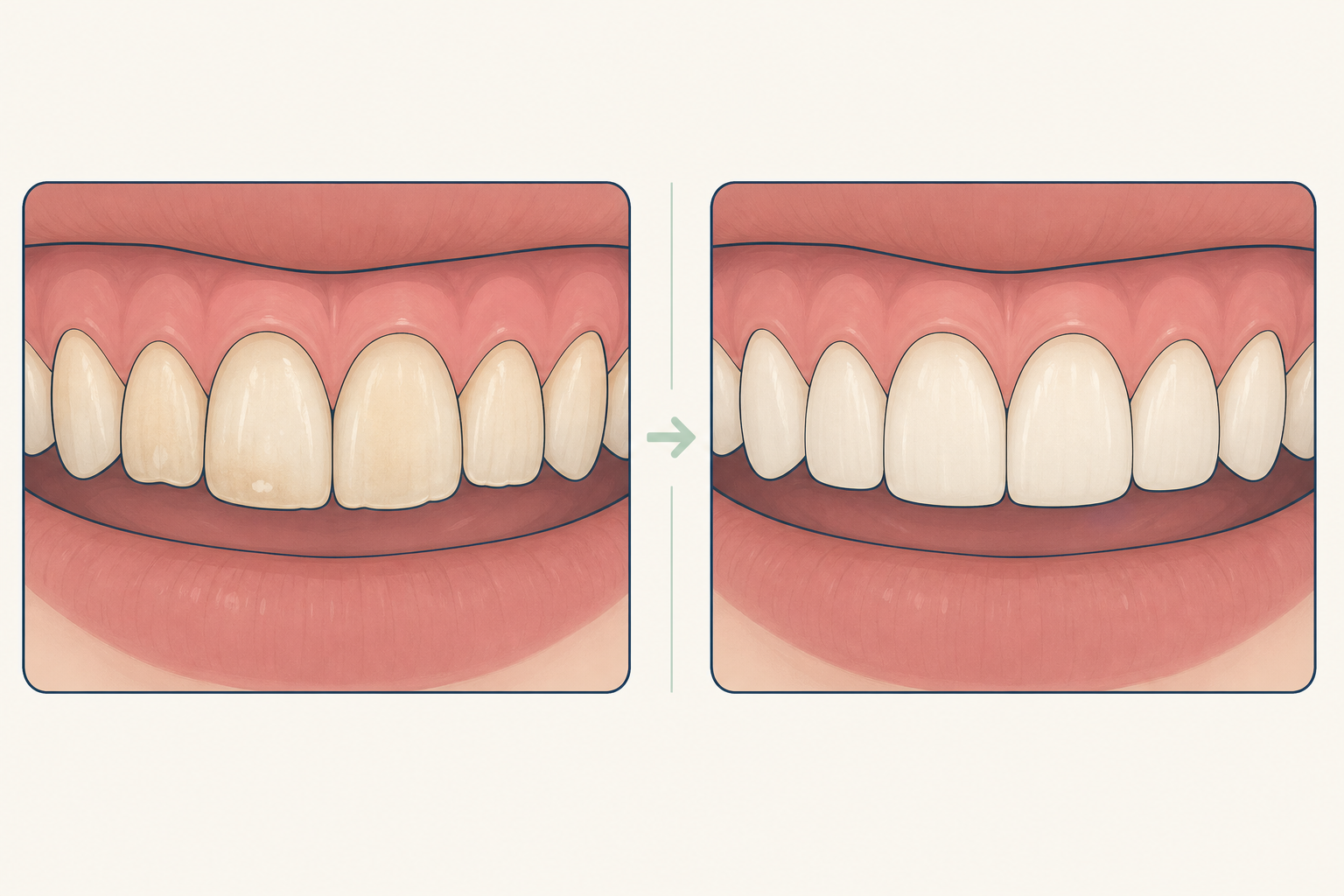
Minimal-Prep Veneers dental educational illustration

What the change looks like

Illustrative diagram: Minimal-Prep Veneers
Illustration — a representative diagram, not a patient photo.
The DN Glow Up1,699 AED
Book The DN Glow Up

What affects the cost of minimal-prep veneers?

Clinical features considered with minimal-prep veneers
FeatureWhy it matters
Marginal fitFit is one of the outcomes examined when conventional and minimal-preparation veneers are compared.[3]
Colour stabilityColour stability is another outcome considered in the comparison.[3]

[3]

What are minimal-prep veneers?

They are a veneer approach considered alongside conventional veneers and no-preparation veneers. The comparison includes appearance, longevity, periodontal health, patient satisfaction, microleakage, marginal fit, cement thickness, and colour stability.

[3]

Who might consider minimal-prep veneers?

Minimal-prep veneers are relevant when a person is considering a veneer change and wants the preparation approach assessed alongside conventional and no-preparation options.

[3]

Does it hurt?

Preparation is part of this veneer approach, so comfort should be planned around the specific tooth preparation and restoration process rather than assumed from the word minimal.

[2][3]

Is it safe?

A safe plan weighs the optical and mechanical properties of the restorative material and follows precise treatment protocols. Long-term complications still need to be considered.

[2][3]

How long does it last?

Longevity is one of the outcomes evaluated when minimally invasive and conventional veneers are compared. It should be weighed with marginal fit, microleakage, periodontal health, and colour stability.

[1][3]

What happens during treatment?

Veneer preplanning can use digitally guided tooth preparation. For porcelain veneers, the usual sequence can include a small amount of enamel removal, an impression or 3D scan, laboratory fabrication, fit adjustments, cleaning, and bonding.

[3]

What is recovery like?

A porcelain veneer may be temporary while the custom veneer is made. At placement, the veneer is checked for fit and shape before it is bonded.

[1][3]
Steps used for a porcelain veneer
StageWhat happens
RecordsAn impression or 3D computer model is made for the dental laboratory.[1][3]
FittingFit and shape are checked, adjustments are made, then the tooth is cleaned and the veneer is bonded.[1][3]

[1][3]

What are the alternatives?

The main veneer material choices are porcelain and composite. Porcelain is a custom-made thin shell on the front surface of a tooth, while composite is tooth-coloured filling material bonded to the tooth.

[1][3]

What should you expect from the appointment?

The planning discussion should cover the appearance goal, preparation method, marginal fit, cement thickness, and the material properties needed for the restoration.

[3]

What should you ask about payment?

Porcelain veneers tend to cost more than composite veneers. Composite veneers may need less enamel removal and fewer visits, while porcelain veneers are stronger, longer-lasting, and more stain- and wear-resistant.

[1][3]

Frequently asked questions

Can a minimal-prep veneer be compared with a no-prep veneer?

Yes. Minimal and no-preparation veneers are both included in comparisons with conventional veneers, with attention to longevity, periodontal health, fit, microleakage, cement thickness, and colour stability.

[3]