
Full denture versus partial denture?
Count the natural teeth still present in the arch: none points to a full denture.
[1][3]The short answer
A full denture replaces every tooth in one arch when that arch has no natural teeth left A partial denture is used when natural teeth remain and there are particular spaces to fill Its clasps attach to those remaining teeth and help keep them from moving into the gaps The deciding fact is the number of natural teeth still present in the arch
[1][3]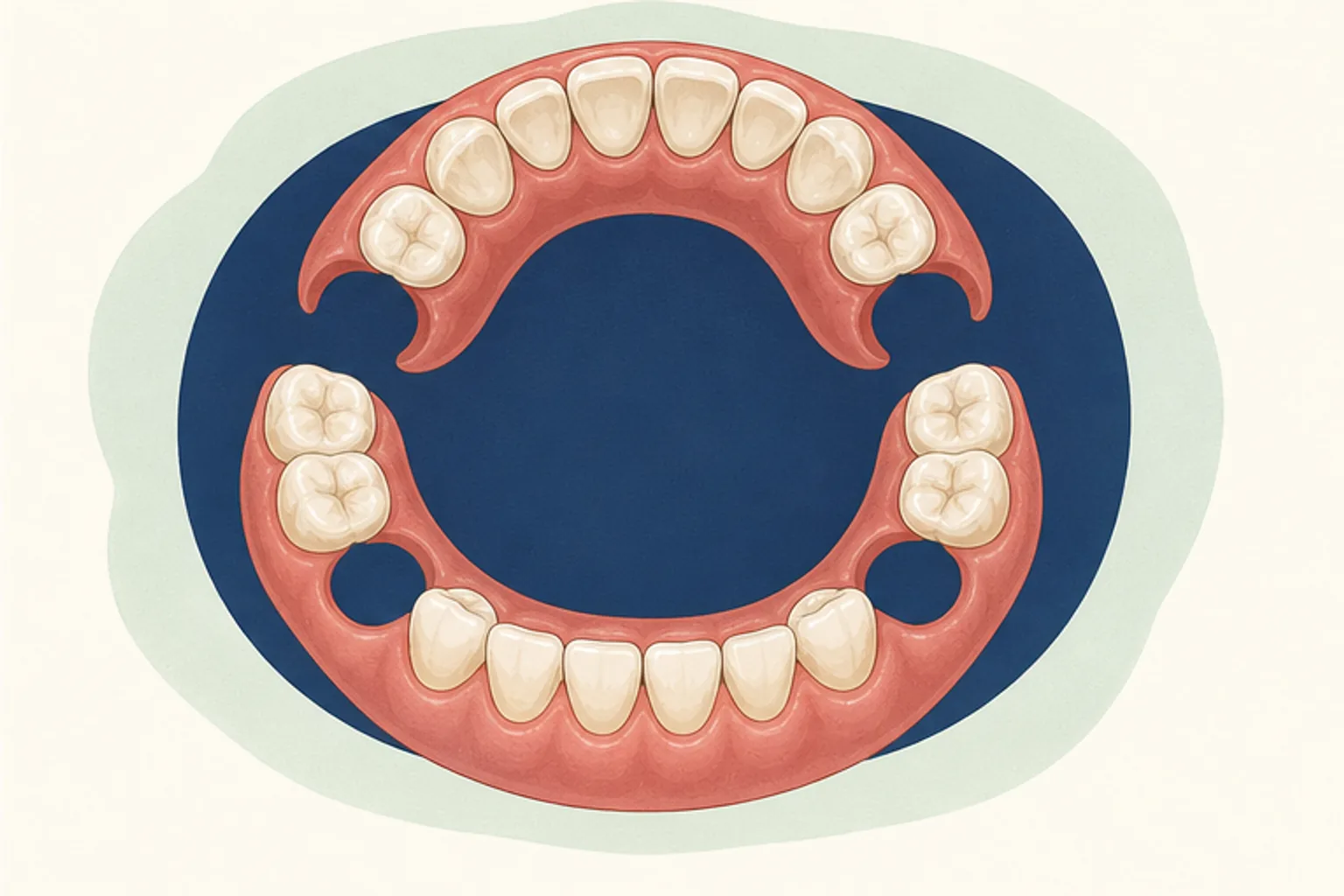
The tooth count in one arch sets the choice
This is an arch-by-arch distinction The question is not simply whether teeth are missing somewhere in the mouth It is whether the arch being considered still has natural teeth An arch with none remaining calls for replacement of the entire set; an arch with some remaining has gaps rather than a completely toothless arch
[1][3]| Answer part | What the research shows |
|---|---|
| Direct answer | A full denture replaces every tooth in one arch when that arch has no natural teeth left.[1][3] |
| What changes it | A full denture is the option described for an arch in which no natural teeth remain. Its scope is all the teeth in one arch, rather than selected missing-tooth spaces. That complete replacement is what separates it from a partial denture.[1] |
A full denture replaces the whole set in that arch
A full denture is the option described for an arch in which no natural teeth remain Its scope is all the teeth in one arch, rather than selected missing-tooth spaces That complete replacement is what separates it from a partial denture
[1]A partial denture works around teeth that remain
A partial denture fills the specific spaces left by missing teeth when other natural teeth are still present in the same arch It does not replace every tooth in that arch, because some are already there
[3]The clasps of a partial denture attach to the natural teeth that remain Those clasps also help prevent the remaining teeth from drifting toward the empty spaces This supporting role belongs to the partial-denture situation, where there are still teeth available in the arch
[3]| Stage | Source-backed step |
|---|---|
| When to get help | A partial denture fills the specific spaces left by missing teeth when other natural teeth are still present in the same arch. It does not replace every tooth in that arch, because some are already there.[3] |
| Decision step | The choice follows a simple clinical distinction: no natural teeth in the arch means a full denture replaces that arch's teeth; natural teeth still present means a partial denture fills the gaps between them.[1][3] |
Use the remaining natural teeth as the deciding measure
The choice follows a simple clinical distinction: no natural teeth in the arch means a full denture replaces that arch's teeth; natural teeth still present means a partial denture fills the gaps between them The classification changes if the count of natural teeth differs from one arch to the other
[1][3]Frequently asked questions
When is a full denture used,?
A full denture replaces all the teeth in one arch when no natural teeth remain in that arch
[1]When is a partial denture used,?
A partial denture fills specific gaps when some natural teeth are still present in the arch
[3]What do the clasps on a partial denture do,?
They attach to remaining teeth and help keep those teeth from drifting into the empty spaces
[3]Who wrote this page
This library is published by Dental Nation, a licensed dental group practising in the United Arab Emirates. Pages are written and overseen by the same clinical team that treats patients in our clinics, and are held to a fixed editorial standard for safety and accuracy.
This page is patient education, not medical advice, and cannot replace an examination. Anything urgent — facial swelling, trauma, uncontrolled bleeding or severe pain — needs a dentist or emergency care now.