
Full-Mouth Reconstruction
Restorative care can repair damaged, decayed, or missing tooth surfaces with direct or laboratory-made restorations.
[1][2]The short answer
Full-mouth reconstruction is a planned programme of restorative care that assesses the whole mouth before repairing or replacing damaged, decayed, or missing tooth surfaces.
[1]
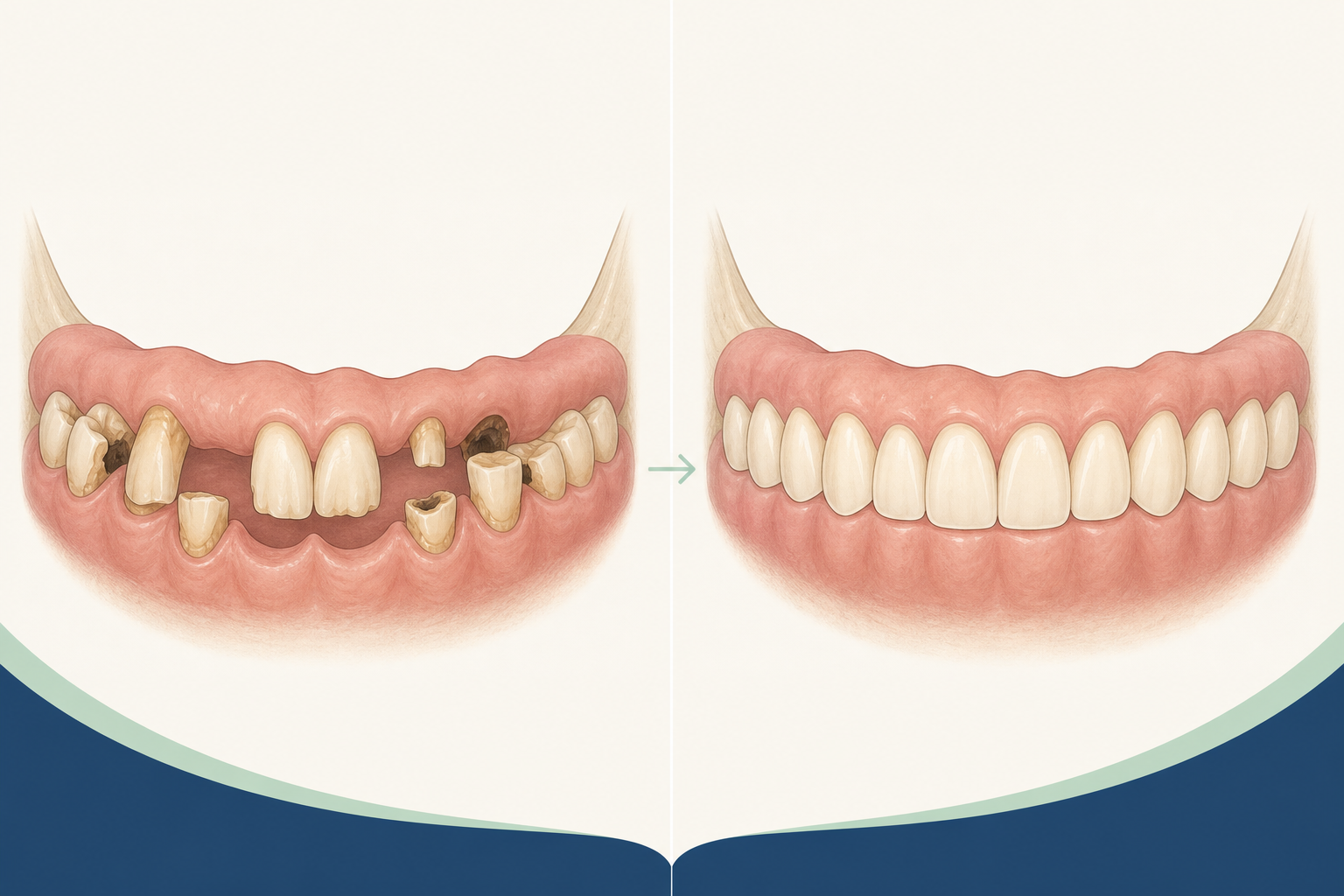
What the change looks like
What is full-mouth reconstruction?
Who may need it?
It may suit people whose dental problems involve several teeth or several types of repair, such as decay, tooth wear, or missing surfaces. Assessment can include a pocket chart, full-mouth periapical radiographs, and a caries and restorative diagnosis.
[1]Does it hurt?
The programme can involve fillings, crowns, veneers, bridges, or other restorations, and indirect restorations may require several visits for moulding, fabrication, and placement. The materials used include cements, adhesives, impression materials, liners, polishing agents, and temporary materials intended to support comfortable restorations.
[1][2]Is it safe?
How long does it last?
The materials do not have one shared lifespan. Regular monitoring detects staining, wear, leakage, or failure early, while glass ionomer cements can provide a longer-term solution without a fixed requirement for further treatment within a particular period.
[1]What happens during the procedure?
The process starts with examination and imaging, including pocket charting when appropriate and full-mouth periapical radiographs to assess apical pathology and bone levels. The restorative work is then selected for each defect: direct materials can be placed on the tooth, while crowns, veneers, and bridges are custom made in a laboratory before placement.
[1][2]What is recovery like?
Recovery is managed through a continuing programme of review. Carious lesions remain under active surveillance, and teeth treated with vital pulp therapy need regular checks of pulp vitality. The care pathway also uses ongoing monitoring and review of goals rather than treating the mouth as finished after one visit.
[1]What are the alternatives?
A restoration does not always need complete replacement. Polishing and refinishing, resealing a defective margin, or repairing a specific fractured area can preserve sound material; full replacement is reserved for extensive caries or major failure.
[1]What should you expect?
How is it charged?
Charges depend on the course of treatment. In the care-pathway example, a Band 3 treatment provided within three months can be capped at the difference between the Band 2 pathway charge and the full Band 3 charge; other courses carry the relevant patient charge.
[1]Frequently asked questions
Can a restoration be repaired instead of replaced?
Yes. A defective margin may be resealed or a fractured area repaired, preserving sound material; complete replacement is used for extensive caries or major failure.
[1]