
What the change looks like
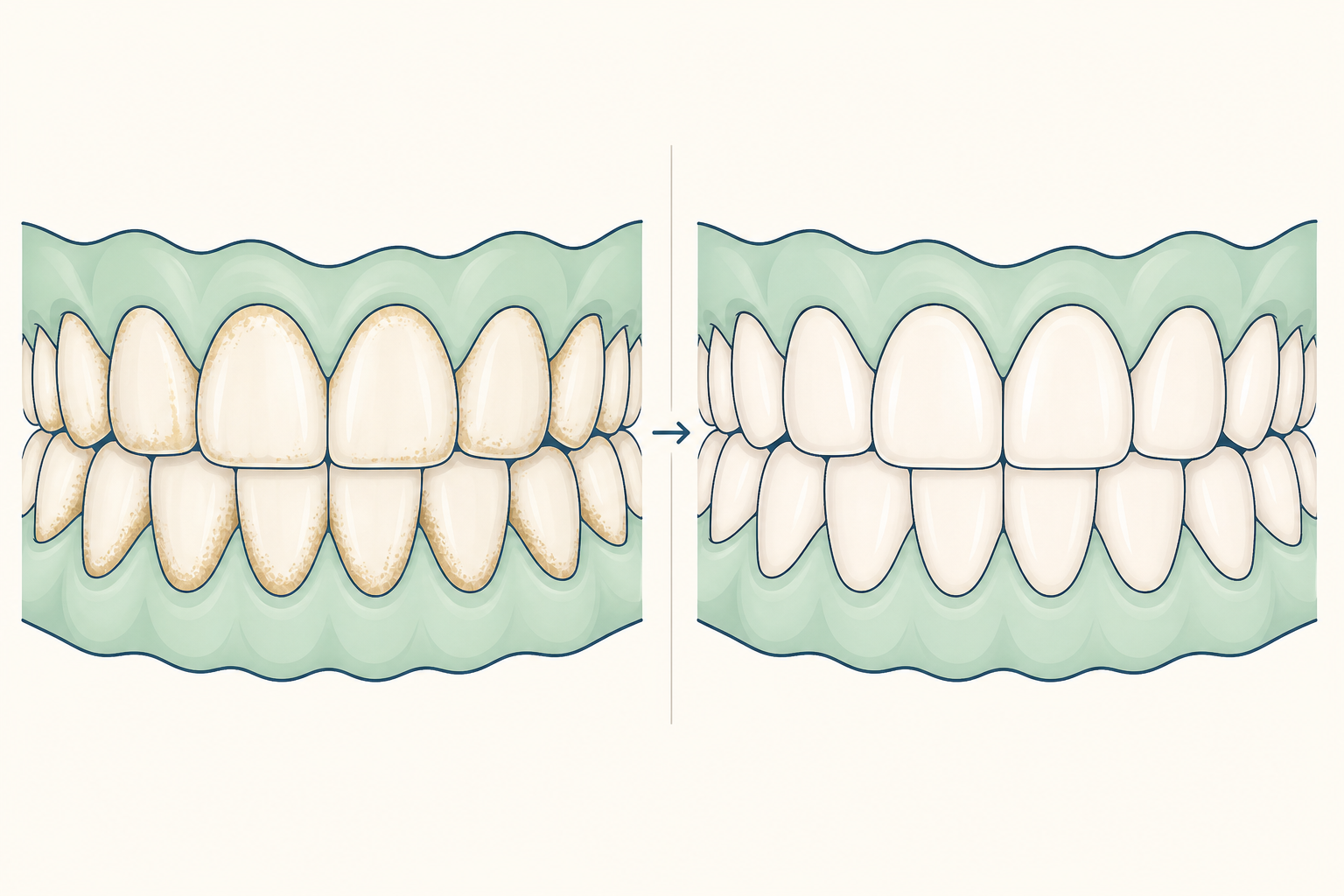
What is AirFlow stain removal?
Who may consider it?
Air polishing was studied in 35 participants with moderate to heavy staining on both sides of the upper teeth. It is intended for visible dental stain removal, while deeper gum treatment uses scaling and root planing to remove plaque and tartar above and below the gumline.
[1]Does it hurt?
The 40 µm sodium bicarbonate powder was selected for patient comfort, and patient acceptance did not differ significantly between the two powder sizes in the study.
[1]Is it safe?
Air polishing can cause discomfort when powder affects soft or hard tissues. Air emphysema has been reported after supragingival sodium bicarbonate polishing, although no adverse events or symptoms occurred during or after treatment in the 35-person study.
[1]How long does it last?
The stain-removal procedure itself took about four and a half minutes in the clinical study. The recorded time varied with the intensity and extent of staining.
[1]What happens during the procedure?
The powder is directed at stained tooth surfaces until the visible stain is removed. The study compared 40 µm and 65 µm sodium bicarbonate powders and recorded the time needed to remove all stains.
[1]What is recovery like?
Patients completed an acceptance questionnaire immediately after treatment, and most answers were rated good or excellent. Scaling and root planing has a different recovery pattern, including possible pain for one or two days and sensitivity for up to a week.
[1]What are the alternatives?
What should I expect?
Powder choice may be made between 40 µm and 65 µm sodium bicarbonate. Their stain-removal times, operator opinions and patient acceptance were comparable in the split-mouth study.
[1]