
Can one tooth have a veneer?
Single-tooth veneer placement is technically feasible when front-surface restoration is suitable; the challenge is replicating shade.
[1]The short answer
Yes, one tooth can receive a veneer when a front-surface restoration is suitable. Matching shade, translucency, contour and the bite with neighbouring teeth can make a single-tooth case more demanding.
[1]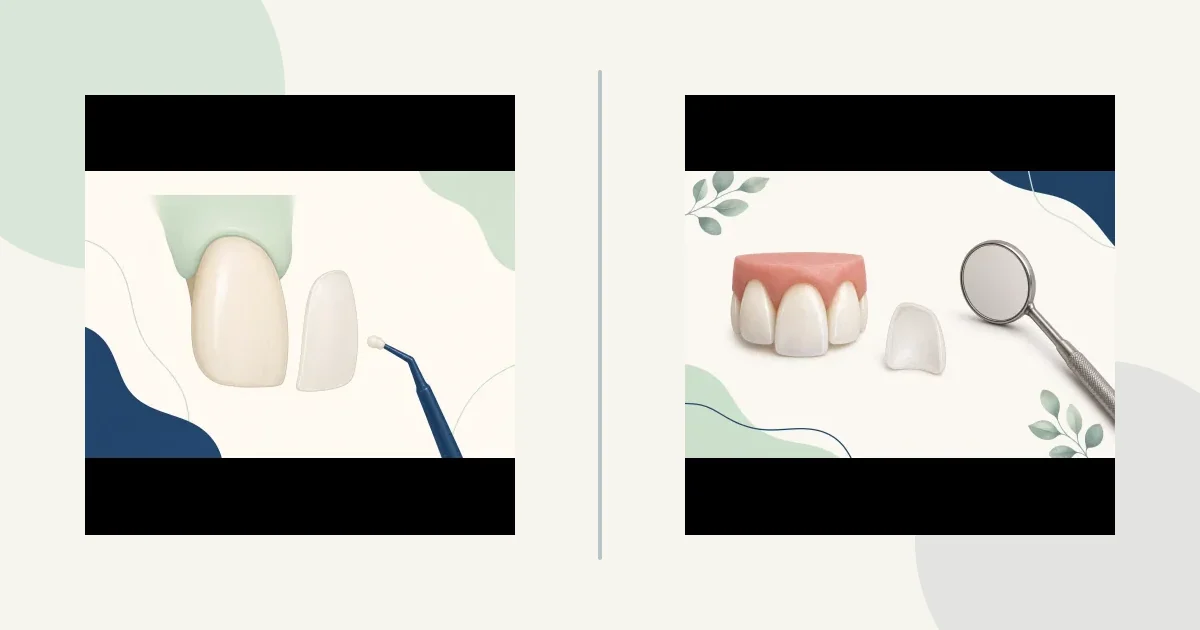
Single-tooth eligibility
| Answer part | What the research shows |
|---|---|
| Direct answer | Yes, one tooth can receive a veneer when a front-surface restoration is suitable. Matching shade, translucency, contour and the bite with neighbouring teeth can make a single-tooth case more demanding.[1] |
| What changes it | Because the surrounding teeth are not prepared, the clinician must replicate their exact visual properties in a single new restoration.[1] |
Why shade and contour matching is harder with one tooth
Because the surrounding teeth are not prepared, the clinician must replicate their exact visual properties in a single new restoration. Light passes through enamel differently at different thicknesses; the target veneer must achieve the same optical result without altering adjacent teeth.
[1]Disease and bite factors that affect the decision
Active periodontal disease and untreated decay require resolution first, because a cosmetic shell placed over an unhealthy tooth cannot stabilise the underlying problem. Bruxism, heavy clenching and a pronounced deep bite reduce the expected lifespan of the bonded restoration and may alter the preparation design. Shade selection also depends on the colour and surface texture of neighbouring teeth.
[1]| Stage | Source-backed step |
|---|---|
| When to get help | Active periodontal disease and untreated decay require resolution first, because a cosmetic shell placed over an unhealthy tooth cannot stabilise the underlying problem.[1] |
| Decision step | When structural damage extends beyond the visible facial surface, full-coverage restoration becomes the more appropriate clinical choice.[1] |
When full-coverage or repositioning is the right path instead
When structural damage extends beyond the visible facial surface, full-payer review restoration becomes the more appropriate clinical choice. Repositioning with fixed appliances or clear aligners is the route when the underlying tooth position is the problem rather than the surface appearance.
[1]Frequently asked questions
Why does enamel removal matter for a single-tooth veneer,?
Traditional veneer preparation is not reversible because a thin layer of enamel is removed to accommodate the restoration. The amount depends on the starting tooth shape, material chosen and any existing restorations. Once removed, that enamel cannot be replaced.
[1]Can clenching or grinding affect whether one tooth is suitable for a veneer,?
Clenching and grinding place higher-than-normal forces on the restoration. A deep overbite can also load the veneer in a way that raises fracture risk. The clinician evaluates the bite before confirming suitability and may recommend a protective appliance.
[1]When does the scope of damage on one tooth make a crown the better option,?
Full-payer review restoration becomes appropriate when front-surface correction alone cannot address the extent of the damage, when the tooth already carries large existing restorations, or when the primary clinical need is structural support rather than cosmetic improvement.
[1]Who wrote this page
This library is published by Dental Nation, a licensed dental group practising in the United Arab Emirates. Pages are written and overseen by the same clinical team that treats patients in our clinics, and are held to a fixed editorial standard for safety and accuracy.
This page is patient education, not medical advice, and cannot replace an examination. Anything urgent — facial swelling, trauma, uncontrolled bleeding or severe pain — needs a dentist or emergency care now.