
Trigeminal Neuralgia
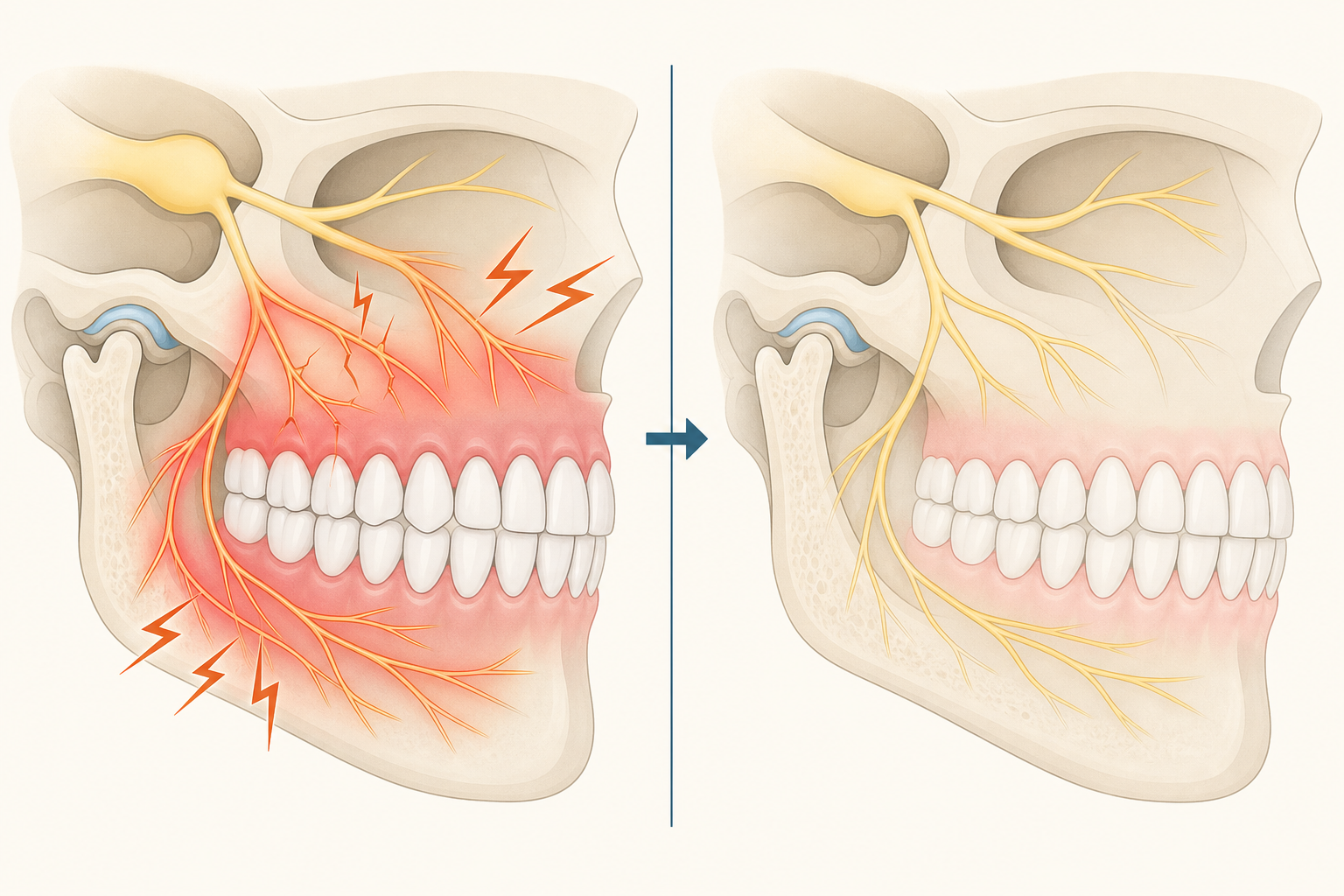
Trigeminal neuralgia causes sudden, severe facial pain in brief attacks that may be triggered by touch, chewing, or brushing.
[1]The short answer
Trigeminal neuralgia causes sudden, severe, brief attacks of facial pain in the trigeminal nerve distribution, often triggered by touch or chewing.
[1]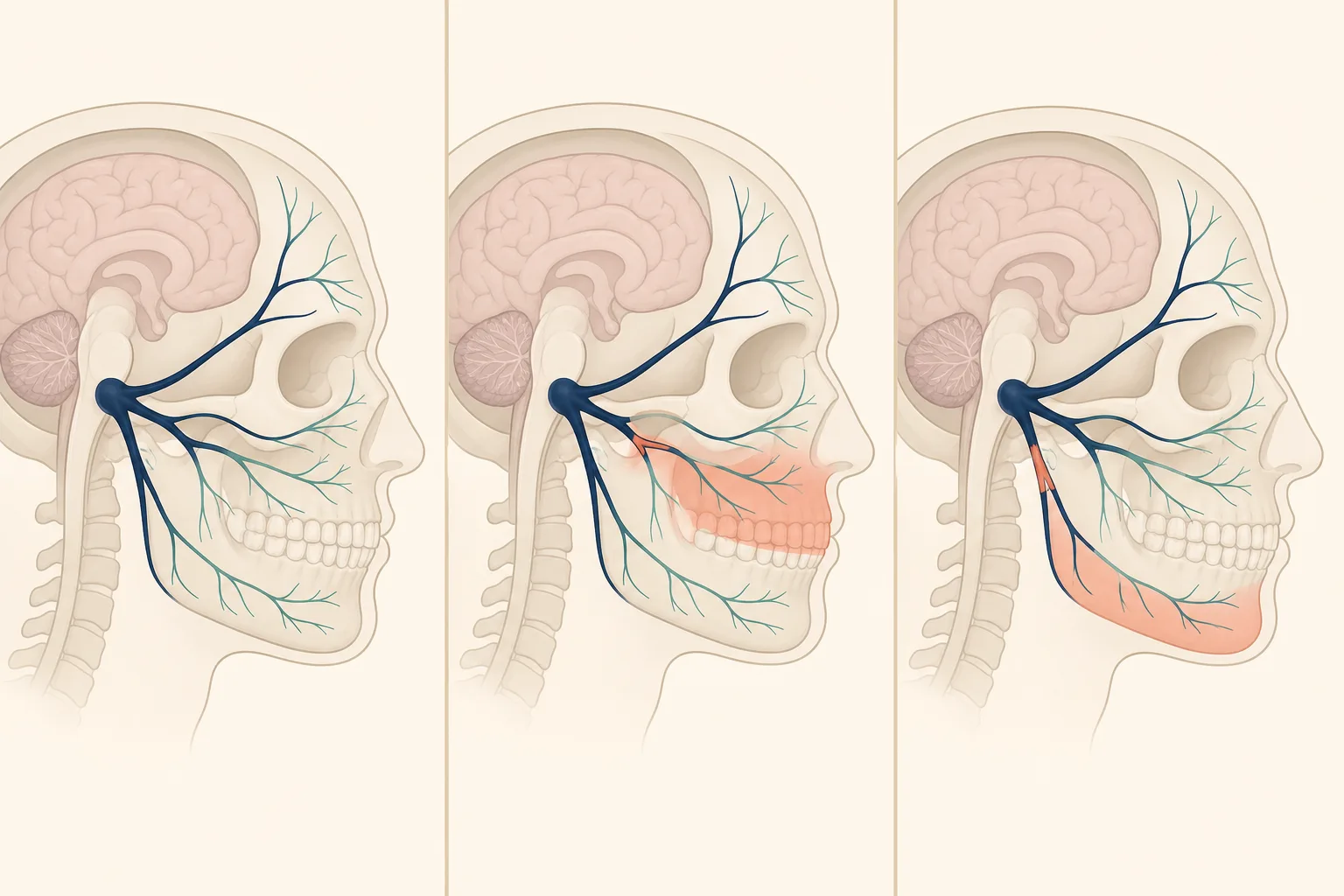
What the change looks like
What symptoms can appear?
| Clinical question | What the assessment considers | Patient-facing next step |
|---|---|---|
| A change noticed by the patient | The timing, trigger, location, and effect on function | Record what changed and arrange a dental assessment[1] |
| A finding after treatment or injury | The tooth, implant, sinus, nerve, or developing teeth may need separate checks | Take the treatment or injury history to the appointment[1] |
What can cause it?
The trigeminal nerve carries sensation from much of the face and also has a motor role in chewing. Trigeminal neuralgia may be associated with contact affecting the nerve, multiple sclerosis, a lesion, or no clear cause after evaluation. A dental trigger or a painful tooth can coexist, so the source of facial pain must be tested rather than assumed.
[1][2]How is it classified over time?
There is no simple symptom stage system that identifies the cause. Clinicians instead consider the pattern of attacks, trigger zones, pain-free intervals, progression, and any persistent sensory or neurological change. A shift from brief triggered attacks to constant pain changes the urgency and the differential diagnosis.
[1]| Clinical question | What the assessment considers | Patient-facing next step |
|---|---|---|
| Earlier or developing finding | The history and examination may show a problem at a different point in its course | Ask what finding supports the classification[1] |
| Established or persistent finding | The next step depends on tissue status, function, and the suspected source | Ask what needs monitoring or treatment[1] |
What raises concern?
Risk assessment includes age, neurological history, the side and distribution of pain, sensory findings, and symptoms outside the usual attack pattern. Dental treatment should be guided by evidence of tooth disease, not by facial pain alone. New numbness, weakness, or other neurological symptoms need prompt assessment.
[1][2]How is it diagnosed?
Diagnosis is clinical and depends on a careful pain history and neurological examination. The clinician maps the affected trigeminal division, asks about triggers and attack duration, and looks for sensory deficits. Imaging may be used to investigate an underlying cause. A dental examination helps exclude tooth, gum, or jaw disease that can mimic the pain.
[1][2]How is treatment planned?
Treatment is usually planned around the pain pattern and its cause. Medicines used for neuropathic facial pain may be considered by an appropriate clinician. Some patients need specialist assessment or a procedure when symptoms persist or a structural cause is found. A dentist should treat a tooth only when the examination supports a dental diagnosis.
[1][2]| Clinical question | What the assessment considers | Patient-facing next step |
|---|---|---|
| A local, repairable finding | Care may focus on the affected tooth, tissue, restoration, or source | Ask which part of the problem the proposed treatment addresses[1][2] |
| A finding needing coordinated care | More than one assessment or a staged plan may be needed | Request the sequence, follow-up, and decision points in writing[1][2] |
What should I ask about cost in Dubai?
A Dubai cost pathway may include dental tests, medical review, imaging, medication management, or specialist treatment, depending on the suspected source of pain.
[1]What can happen if it continues?
Severe recurring pain can interfere with eating, speaking, brushing, sleep, and daily activities. Repeated dental procedures aimed at an unrecognised nerve disorder can add harm without treating the source. Persistent numbness, weakness, visual symptoms, or a major change in the pattern warrants prompt medical assessment.
[1]How can future problems be reduced?
There is no general home method that prevents every case. Prevention of avoidable confusion starts with recording the attacks and seeking an examination before irreversible dental treatment. Keep a note of triggers, duration, location, pain-free periods, and associated neurological symptoms for the clinician.
[1]