
Dental Tori (Bony Growths)
Dental tori are usually painless bony lumps; treatment is considered when they irritate tissue or interfere with dentures or cleaning.
[1]The short answer
Many tori cause no symptoms. A person may feel a hard, smooth lump, notice irritation from food or a denture, or find that cleaning a nearby area is awkward. Pain is not a defining feature, so a new or changing lump still needs an examination.
[1]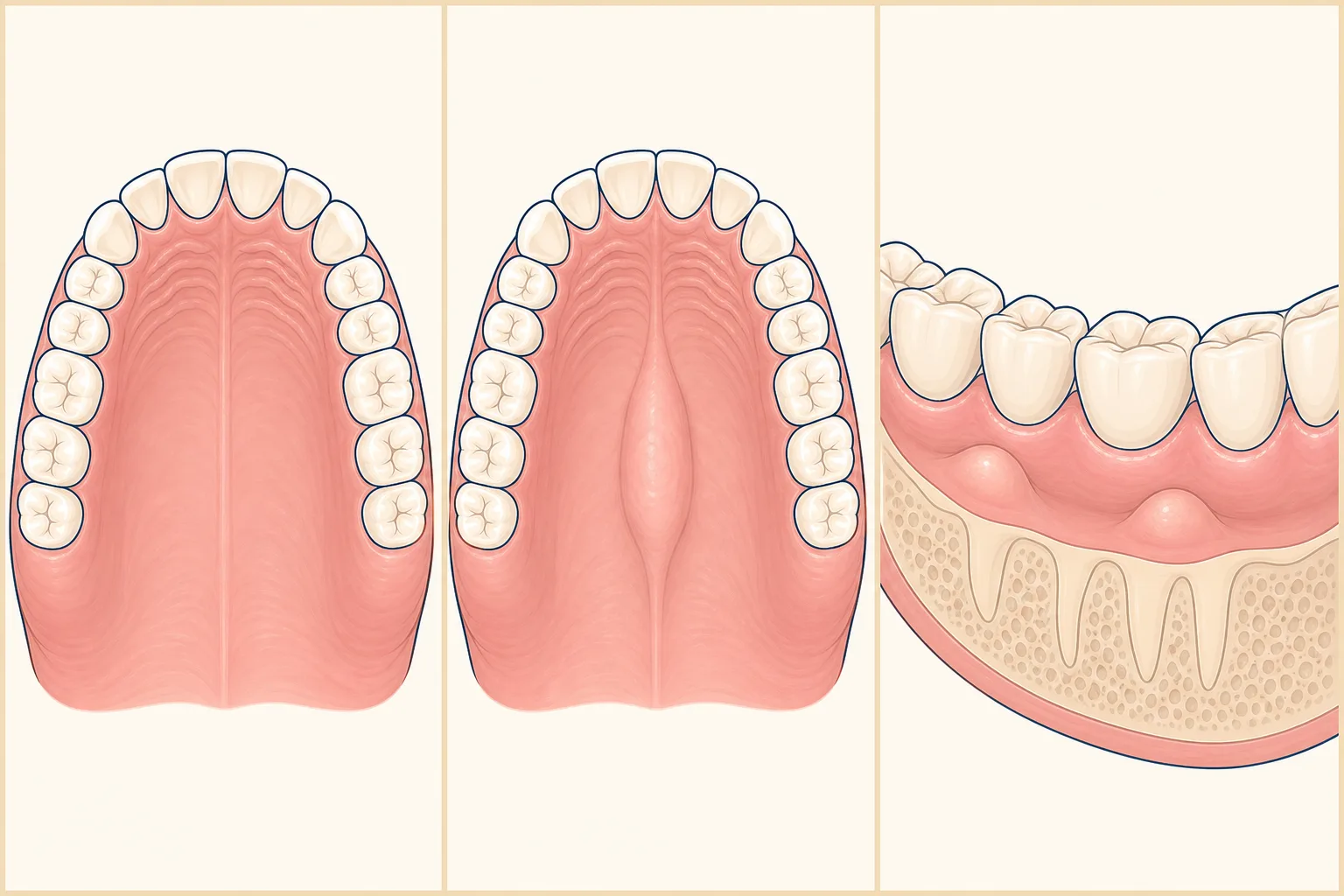
What the change looks like
What symptoms can jaw conditions cause?
| Situation | What the clinician checks | What the finding changes |
|---|---|---|
| A quieter or early presentation | Symptoms, history, and local examination | The need for assessment and monitoring[1] |
| A persistent, larger, or function-affecting presentation | Examination plus imaging or further testing when indicated | The treatment discussion and follow-up plan[1] |
What can cause it?
The cause of dental tori is not settled by the appearance alone. Reported associations include local mechanical forces and inherited or developmental factors. A clinician considers the site, shape, history, and whether the growth has changed.
[1]What are the stages?
Tori are usually described by their location, size, number, and effect on function rather than by disease stages. A small stable growth may simply be recorded, while a growth that interferes with a denture or hygiene may need a treatment discussion.
[1]| Situation | What the clinician checks | What the finding changes |
|---|---|---|
| A quieter or early presentation | Symptoms, history, and local examination | The need for assessment and monitoring[1] |
| A persistent, larger, or function-affecting presentation | Examination plus imaging or further testing when indicated | The treatment discussion and follow-up plan[1] |
Which risks matter?
Dental tori are benign bony growths, commonly found along the inner lower jaw or the roof of the mouth, that may remain stable without treatment.
[1]How is it diagnosed?
Diagnosis is usually clinical because a torus has a characteristic hard consistency and location. Imaging or further assessment may be considered when the finding is unusual, changing, painful, or not clearly bony.
[1]How is treatment chosen by stage?
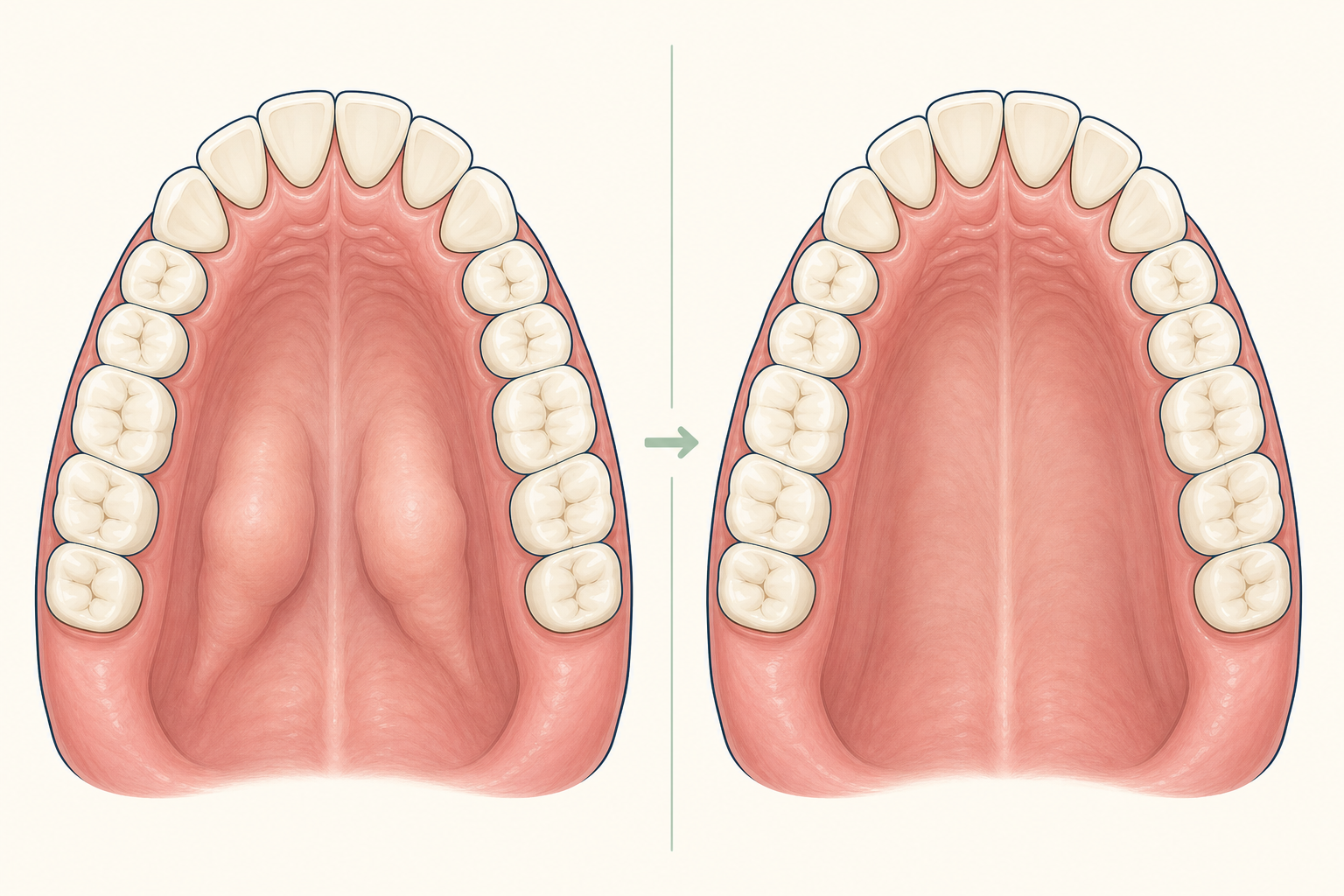
Removal is considered when a torus repeatedly becomes irritated or interferes with a denture, chewing, speech, or keeping the nearby area clean.
[1]| Situation | What the clinician checks | What the finding changes |
|---|---|---|
| A quieter or early presentation | Symptoms, history, and local examination | The need for assessment and monitoring[1] |
| A persistent, larger, or function-affecting presentation | Examination plus imaging or further testing when indicated | The treatment discussion and follow-up plan[1] |
What does care cost in Dubai?
The cost of torus care depends mainly on whether observation is sufficient or removal is needed, along with the procedure and any appliance-related care.
[1]What can happen if it is untreated?
A torus can become irritated by chewing or a removable appliance. An unexpected change in size, surface, colour, or symptoms should be assessed instead of being assumed to be a harmless torus.
[1]How can it be prevented?
There is no evidence-bound home-care step in this assignment that prevents dental tori. Protecting an irritated area from repeated trauma and arranging an examination for change are sensible clinical actions.
[1]Frequently asked questions
Can this be diagnosed from symptoms alone?
A torus is usually recognised by its hard consistency and typical location; an unusual, painful, or changing lump needs a closer assessment.
[1]