Dental Nation
Treatment comparison

Single dark (root-canal-treated) tooth

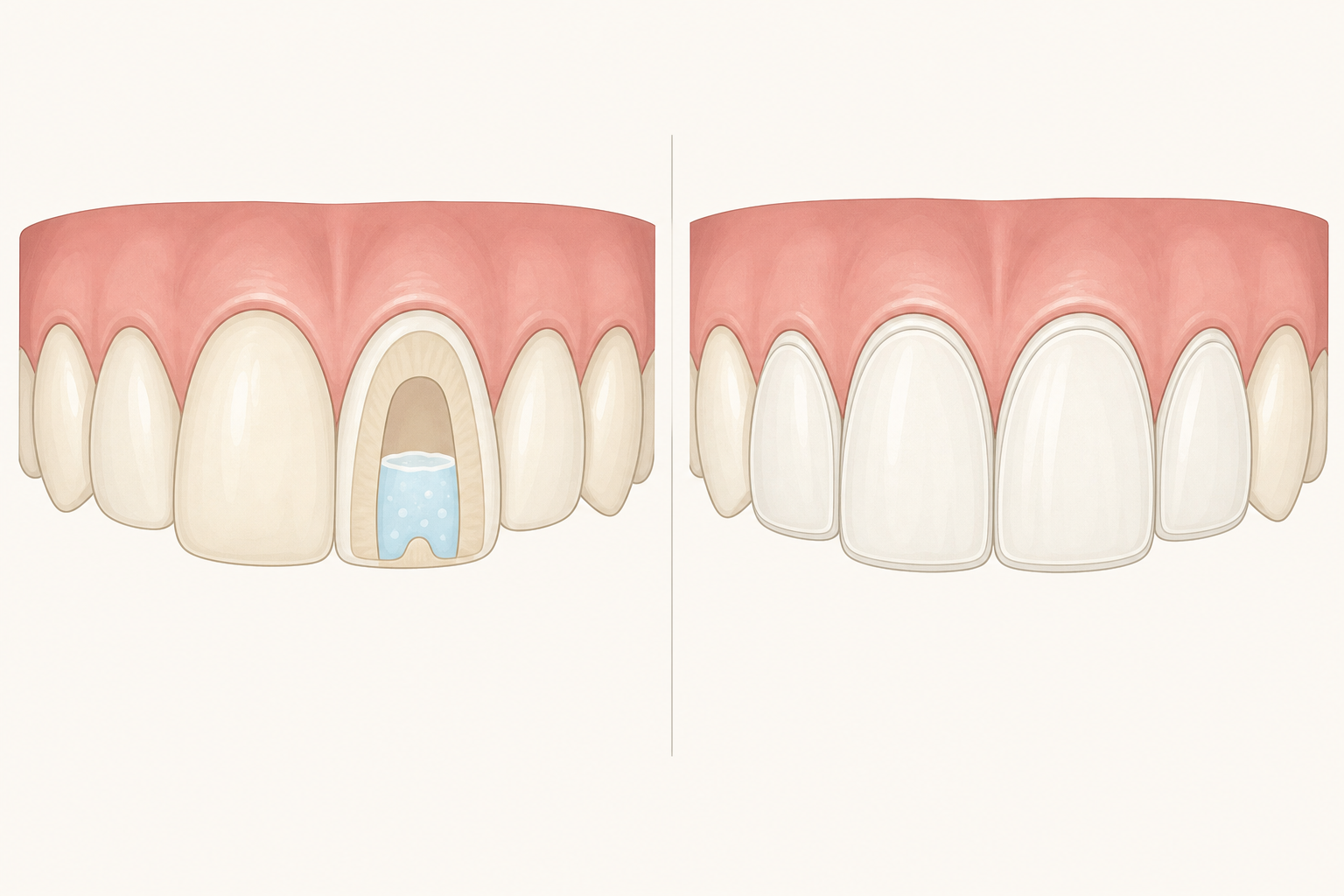
A dark non-vital tooth can be lightened internally, while a veneer changes its front surface with a bonded shell.

[1][2]

The short answer

Internal bleaching lightens a dark non-vital tooth from within, whereas a veneer masks its front surface with a bonded shell.

[1][2]
Single dark (root-canal-treated) tooth comparison graphic

The two options, side by side

Illustrative diagram: internal bleaching vs veneers
Illustration — a representative diagram, not a patient photo.
The DN Glow Up1,699 AED
Book The DN Glow Up

Which option changes the tooth in the right way?

What each approach changes
OptionWhere it actsWhat it uses
Internal bleachingInside a non-vital toothCarbamide peroxide, hydrogen peroxide, or sodium perborate[1][2]
VeneerThe tooth's front surfaceA custom porcelain or composite shell bonded to the tooth[1][2]

[1][2]

Choose internal bleaching if the darkness is inside a non-vital tooth

Intracoronal bleaching is used for discolouration in a non-vital tooth. External whitening is unlikely to remove an intrinsic stain that lies within dentin, so treating the tooth internally addresses a different location from surface whitening.

[1][2]

Choose a veneer if the visible front surface needs changing

A veneer changes what is seen at the front of the tooth. A porcelain veneer is a thin custom-made shell; a composite veneer is tooth-coloured filling material bonded to the tooth. Both routes begin by matching a shade to the surrounding teeth.

[1][2]

Which option usually costs more?

Within veneer choices, porcelain tends to cost more than composite. Porcelain is custom-made in a dental laboratory after an impression or 3D scan, while composite may need fewer appointments and less enamel removal.

[1][2]
Features that separate veneer choices
Veneer typeVisit and preparation patternCost direction
PorcelainImpression or 3D scan, laboratory-made shell, then bondingTends to be more expensive[1][2]
CompositeMay need fewer visits and less enamel removalPorcelain is the higher-cost veneer option[1][2]

[1][2]

How do the maintenance trade-offs differ?

Porcelain veneers are strong and long-lasting. Composite veneers are easier to repair after damage, but they do not resist staining or wear as well. A veneer can chip, crack, wear down, or loosen over time, which can mean re-bonding, repair, or replacement.

[1][2]

What risks should you weigh?

External cervical resorption has been reported rarely after internal bleaching of non-vital teeth. Veneer placement removes a small amount of enamel from the front and sides, and placing a veneer over an unhealthy tooth can leave the underlying problem untreated.

[1][2]

When is neither choice the right first step?

Existing restorations generally do not change colour with whitening, and metallic or other restorative materials can affect the colour seen in a tooth. That makes the colour and position of each restoration part of the decision before either approach is chosen.

[1][2]

What should the decision compare?

Start by locating the discolouration: internal bleaching is for a non-vital tooth, whereas a veneer covers the facial surface. Then weigh enamel removal, the presence of restorations that will not whiten, and whether porcelain or composite better fits the desired repair and wear trade-off.

[1][2]

Frequently asked questions

Will whitening change an old filling in a dark tooth?

Restorative materials generally keep their colour during whitening, and metallic or other restorations can influence the colour of the tooth.

[1][2]