
Dental Nation
Treatment comparison

Hidden vs standard fixed

Lingual braces sit behind the teeth, while standard braces remain visible on the front surfaces.

[1][2]

The short answer

Lingual braces are fixed behind the teeth for a concealed appearance, while standard braces use visible front brackets and wires.

[1][2]
Hidden vs standard fixed comparison graphic

The two options, side by side
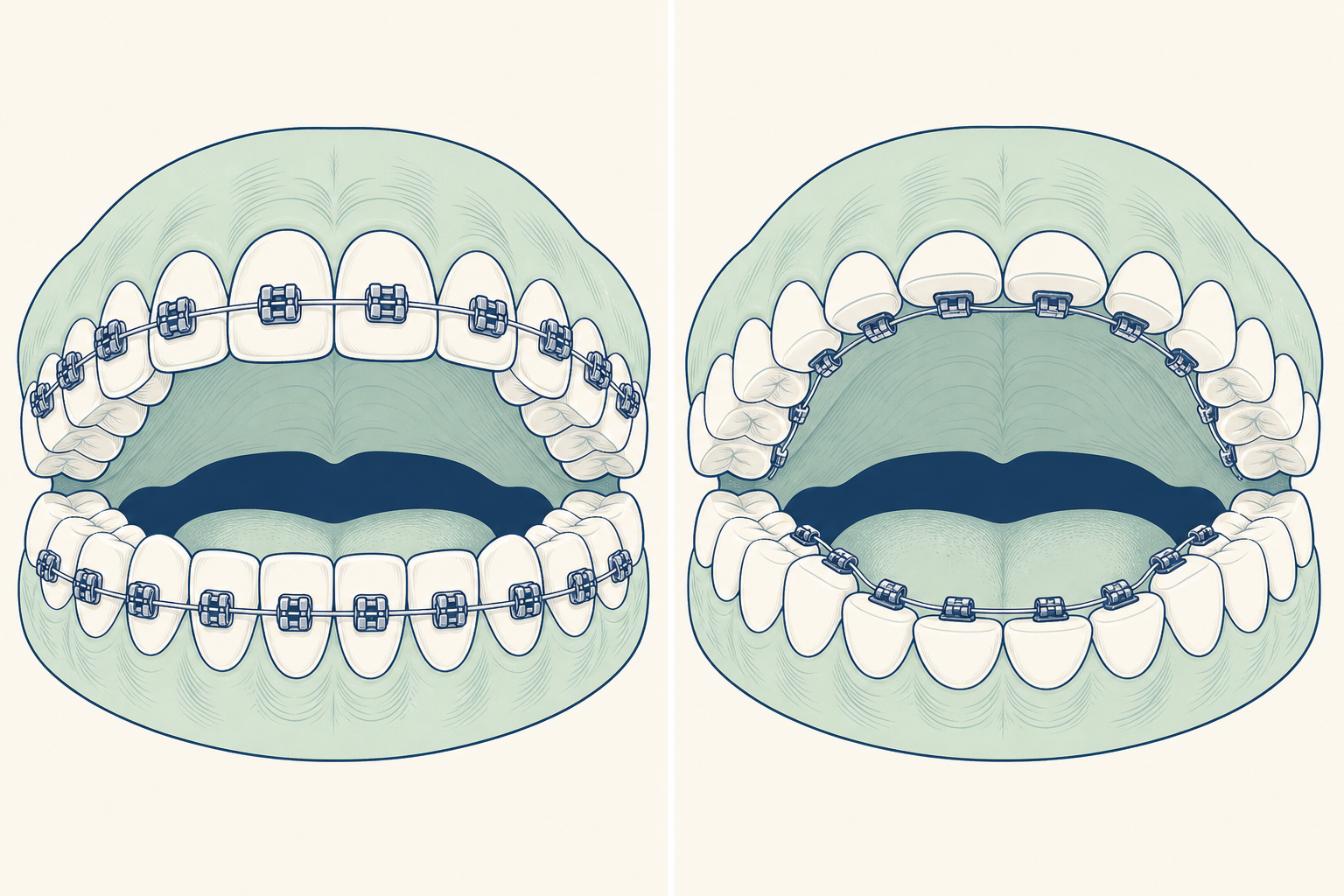
Illustrative diagram: braces vs lingual braces
Illustration — a representative diagram, not a patient photo.
The DN Scan499 AED · fully deducted if treatment starts within 30 days
Book The DN Scan

Which fixed brace is visible?

Where each fixed brace sits
OptionPositionWhat moves teeth
Lingual bracesBehind the teethFixed appliances can provide three-dimensional control[1][2]
Standard bracesOn the front of the teethBrackets and wires apply pressure to move teeth gradually[1][2]

[1][2]

When do hidden braces fit the priority?

Lingual braces suit adults who want their teeth straightened without braces showing on the outside of the teeth. They are fixed appliances and can address a wider range of problems than removable treatments.

[1][2]

When do standard fixed braces fit the priority?

Standard braces stay attached throughout treatment and can treat a wide range of malocclusions, including severely crooked teeth or difficult bites. Their brackets are visible and cannot be removed during treatment.

[1][2]

What differs besides appearance?

Lingual systems may be customised or non-customised, and it is possible to use lingual braces on the upper teeth with standard braces on the lower teeth. Both choices remain fixed to the teeth.

[1][2]
Fixed-brace options in this comparison
OptionCustomisationCombination option
Lingual bracesCustomised and non-customised systems existCan be used on upper teeth with standard braces below[1][2]
Standard bracesBrackets and wires are attached to teethMay be used on lower teeth with lingual braces above[1][2]

[1][2]

What care do fixed braces need?

Clean around braces with a soft-bristled toothbrush and fluoride toothpaste. A water flosser or proxy brush can help reach difficult areas, while hard and sticky foods can damage braces.

[1][2]

What can happen to teeth during treatment?

A small risk with orthodontic treatment is decalcification, which produces white marks on enamel and is usually linked to poor diet and oral hygiene. Lingual braces are less likely than standard braces to leave these marks.

[1][2]

When is a removable option a different choice?

Clear aligners can be removed for eating, brushing and occasional social events, but they treat a narrower set of cases and usually suit light to moderate alignment problems. They can also be lost.

[1][2]

What decides between the two fixed options?

The practical choice turns on whether concealment matters and whether fixed, three-dimensional tooth control is needed. Standard braces move teeth with front brackets and wires; lingual braces place the fixed appliance inside the teeth.

[1][2]

Frequently asked questions

Can I have hidden braces on top and standard braces on the bottom?

Yes. Lingual braces can be used on the upper teeth while standard braces are used on the lower teeth.

[1][2]